Media Law Scenario
Photos and the Law
Welcome to Photos and the Law.
If you arrived through PhotosAndTheLaw.com or an older photography-law link, you are in the right place. Photos and the Law is now preserved and expanded as part of the Harrison Legal Group knowledge archive.
Start with the situation that brought you here. The decision map below covers unauthorized use, licensing beyond the original deal, commercial exploitation, using someone else’s image, releases and locations, and photography contracts.
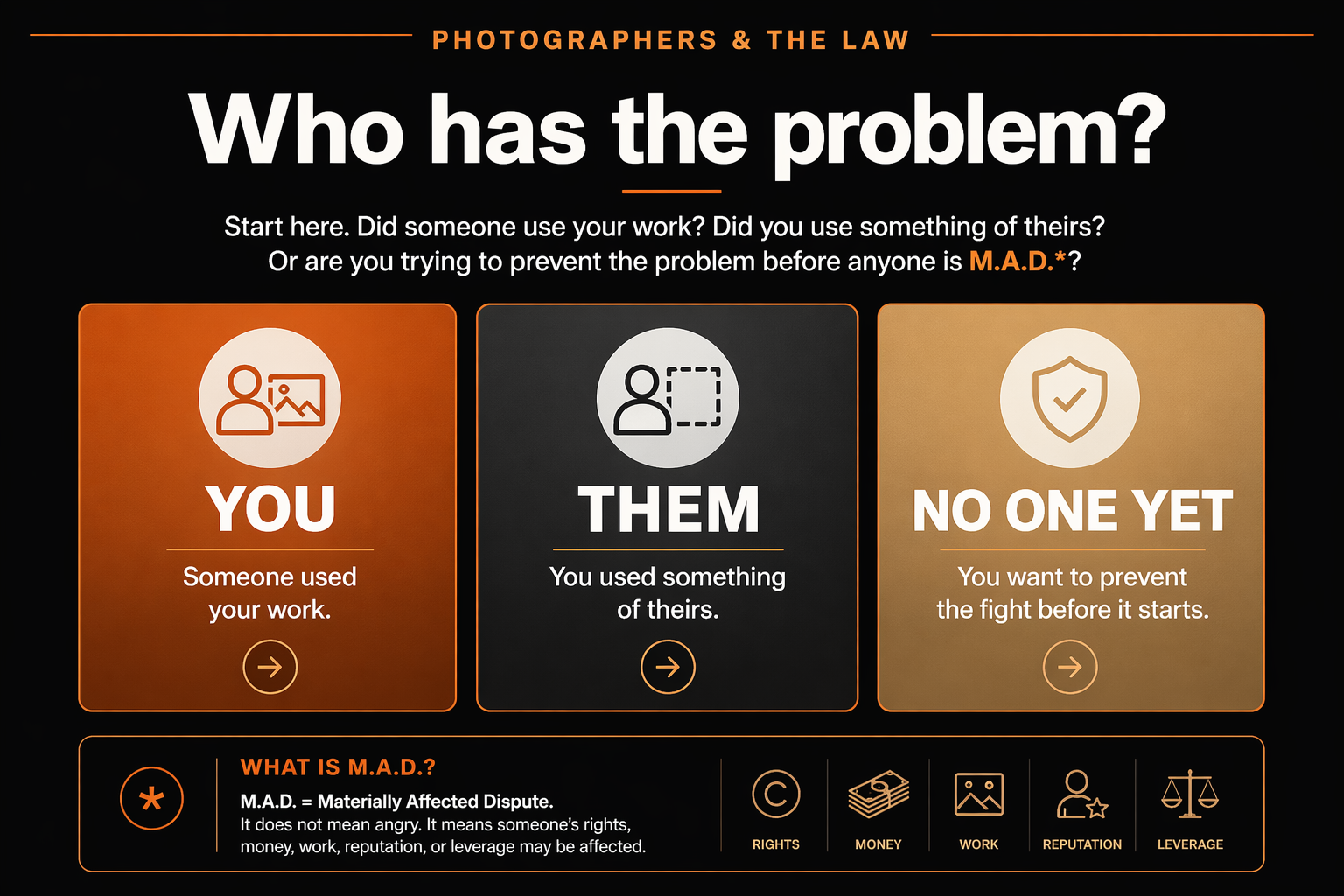
Someone used your work. What happened?
You used something of theirs. What are you worried about?
No one is mad yet. Good.
Someone posted or published your photo without permission
It might be a photo you took. It might be a photo of you. Either way, the first instinct is usually the same: make it stop.
Slow down. What matters most at the beginning is not outrage. It is preservation, context, and leverage.
Preserve the evidence first
Before you send a message, leave a comment, file a takedown, or publicly call anyone out, save what exists. Take full-page screenshots, not just screenshots of the image. Save the URL. Note the date and time. Preserve the caption, surrounding text, account name, publication name, comments, visible ads, product links, and any credit or lack of credit.
If the image disappears tomorrow, your evidence is what remains.
Do not assume every use is the same
A repost by a small account is not the same as use in an advertisement. A news article is not the same as a product page. A credited use may still be unauthorized. An uncredited use may not automatically mean the strongest possible claim.
The details matter because they affect strategy. Sometimes the right answer is a takedown. Sometimes it is a licensing demand. Sometimes it is a correction. Sometimes it is a broader enforcement issue.
Be careful before you escalate
Do not immediately send an angry message. Do not threaten legal action without understanding your position. Do not file a takedown if your real goal may be compensation, licensing, or negotiation.
Once you escalate, you can lose options. The goal is not just to react. The goal is to respond from a position of strength.
Start by figuring out who used the photo, where it appeared, how it was used, whether money was involved, and what you actually want to happen next.
Your client is using images beyond the deal
You got paid. The job is done. Then you see your work somewhere you did not expect.
This is one of the most common problems photographers face—and one of the most misunderstood.
Payment is not ownership
In most cases, your client did not buy the copyright. They bought a license—a defined right to use the images in specific ways.
If the use goes beyond that scope—different platform, different campaign, different product, different duration—that is not a small detail. That is the entire issue.
What to confirm first
- What your agreement actually says (written or implied)
- Where the images are now being used
- Whether the new use is commercial, promotional, or extended in time
- Whether the client shared the images with third parties
The difference between a misunderstanding and a violation is often in the language of the deal.
How to approach it
Do not assume bad intent. But do not assume permission either.
Sometimes this becomes a licensing correction. Sometimes it becomes additional compensation. Sometimes it requires enforcement.
The goal is not to damage the relationship. The goal is to define the boundaries and get paid for the use that is actually happening.
Your image is being used to sell something
This is where the stakes change.
When your image is tied to a product, service, or brand, the issue is no longer just exposure or attribution—it is commercial exploitation.
Why this matters more
Commercial use can affect:
- The value of your work
- Your ability to license the image elsewhere
- Your reputation and implied endorsement
In some cases, it also raises issues beyond copyright—especially if a person is recognizable in the image.
What to document
- Where and how the image is being used (ads, website, social, packaging)
- Whether a product or service is being promoted
- The scale of the use (local, national, online campaign)
- Any connection between your image and the brand message
The more commercial the use, the stronger the leverage tends to be—but only if it is handled correctly.
What happens next
This is often not just about removal. It may be about licensing, compensation, or stopping a use that creates ongoing value for someone else.
The approach matters. Done right, this can be resolved efficiently. Done wrong, it can collapse into a missed opportunity.
You want to use someone else’s image
You found the image. It is online. It fits what you are doing perfectly.
That does not mean you can use it.
Common assumptions that cause problems
- “It was posted publicly”
- “I gave credit”
- “I am not making money from it”
- “Everyone else is using it”
None of those, by themselves, determine whether the use is allowed.
What actually matters
- How you are using the image
- Whether your use replaces the original
- Whether you are adding something new or just taking
- Whether the use has commercial impact
The same image can be low-risk in one context and high-risk in another.
Before you use it
Ask the right question: not “Can I find a way to justify this?” but “What is the risk if I am wrong?”
Sometimes the answer is to get permission. Sometimes it is to license it. Sometimes it is to avoid it entirely. And sometimes it may be defensible—but that is a decision, not an assumption.
You photographed a person and now want to use the image
Taking the photo and using the photo are not the same question.
You may have had every right to press the shutter. That does not automatically mean you can use the image however you want afterward.
What changes when you use the image
The moment you publish, license, or attach the image to something, new issues come into play—especially if the person is identifiable.
- Are you using the image commercially or editorially?
- Does the use suggest endorsement or association?
- Was there any agreement, release, or expectation at the time?
- Is the setting public, private, or controlled?
A candid street photograph and an advertisement are treated very differently—even if the image is the same.
Where people get into trouble
The risk usually is not in taking the photo. It is in how the image is later used, licensed, or repurposed.
Using a person’s likeness to promote something, imply endorsement, or generate commercial value can create exposure that did not exist at the moment the photo was taken.
Before you use it
Think about the context you are placing the person into. Ask whether the use changes the meaning of the image or creates a commercial connection.
Sometimes the answer is a release. Sometimes it is limiting the use. Sometimes it is choosing not to use the image in that way at all.
You photographed in a location and now want to use the image
Where you took the photo matters. But how you use it matters just as much.
“Public” is not a blanket permission, and “private” is not always a complete restriction. The details of the location and the use both matter.
What to consider
- Was the space truly public, or privately owned but open to the public?
- Were there posted restrictions, permits, or conditions of entry?
- Does the location have recognizable branding, artwork, or protected elements?
- How are you planning to use the image—editorial, portfolio, or commercial?
A photo taken in a space can be acceptable in one context and restricted in another, especially when the image is tied to promotion or advertising.
Where issues arise
Problems tend to show up when an image is used in a way that suggests endorsement, commercial affiliation, or access that was not actually granted.
This can involve property rights, contract restrictions, or the use of protected designs and displays within the space.
Before you use it
Look at both the location and the intended use together. The risk is not just where you stood when you took the photo—it is what the image is doing now.
Sometimes the answer is simple. Sometimes it requires permission, a license, or a different use altogether.
You need a photography contract that actually protects you
Most problems do not start with a dispute. They start with a vague agreement.
If the contract does not clearly define what is being delivered and how it can be used, you are leaving the most important parts of the relationship open to interpretation.
What a real contract needs to cover
- Who owns the images
- What rights the client is receiving (and what they are not)
- Where, how, and for how long the images can be used
- Payment structure, deposits, and what happens if payment stops
- Cancellation, rescheduling, and delivery terms
- Liability, risk, and what happens if something goes wrong
Without clarity on these points, you are not avoiding conflict—you are delaying it.
Why this matters
When something unexpected happens—extended use, unpaid invoices, misuse of images—the contract is what determines whether you have leverage or just a disagreement.
A strong contract does not make you difficult. It makes expectations clear on both sides.
Before the next job
The best time to fix this is before you need it. Once a problem starts, you are working from whatever terms already exist—written or not.
Get it defined up front so you are not trying to reconstruct it later.
Not sure where this fits?
Start with what happened. Who used what? Who created it? Where did it appear? Was money involved?